|
Most founders know how to build a product. Fewer know what actually protects it. That gap has a name: defensibility. And it is where most pitches fall apart.
Defensibility almost never comes from what you think it does. Speed and features feel like progress, so they get the attention. The things that actually protect a business: data that accumulates quietly, workflows nobody wants to rip out, channel relationships that took years, tend to go unnamed and underbuilt. Until a competitor launches something similar, and you find out whether your customers had a reason to stay.
|
|
↳ This week in 10 seconds
The moat is not what you built.
It is what nobody else can.
|
|
For years, a good product was enough. Recurring revenue and a story about margins could get you funded. That is changing. Investors are increasingly funding what is hard to replicate. Hardware went from 9% of venture funding in 2023 to 23% in 2026, according to Peter Walker at Carta. The pattern is consistent: investors are asking harder questions about what actually protects a business.
|
Good traction is not enough anymore. The question investors are sitting with is not “is this working?” It is “what stops someone else from doing the same thing?”
|
The honest answer is rarely the roadmap. Speed gets matched. Features get copied. What actually holds customers is harder to see and harder to build, which is also why most founders underinvest in it.
|
|
→ Why founders get passed on
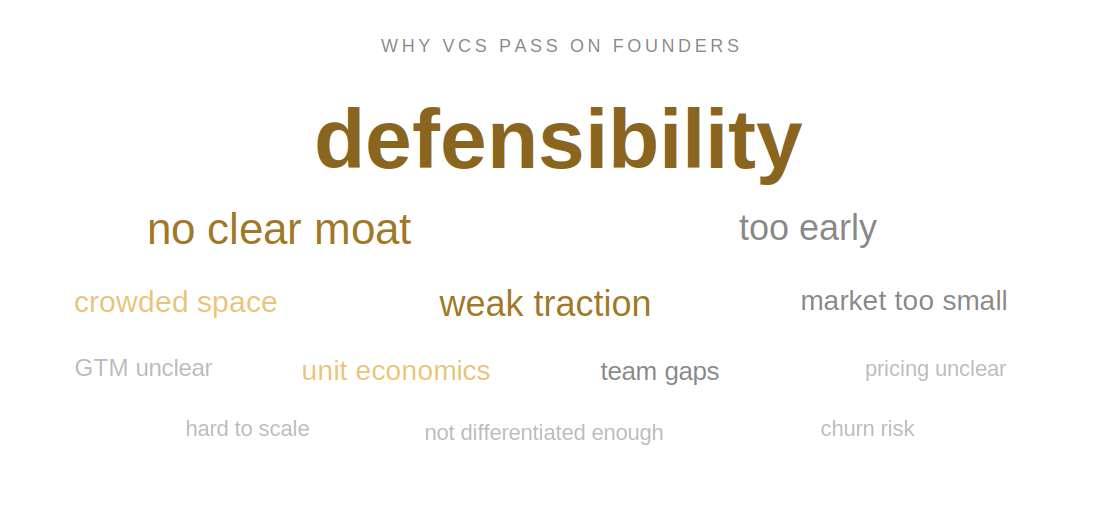
Defensibility is the most common reason VCs say no. Most founders never see it coming.
It is the reason a VC leans in during your demo, loves the product, and still passes. One founder in our community got this feedback after months of fundraising: “Impressive traction. Hard to see the long-term defensibility. Sitting on the sidelines for now.”
The mistake is treating it as something you sort out later. By the time an investor asks the question, it is already too late.
|
|
→ But what about founders?
The defensibility advantage is probably already there. It just has not been prioritised.
The most common mistake is treating your product and your defensibility as the same thing. The defensibility is what makes you genuinely hard to replace, even for a competitor shipping something similar.
|
Most founders we talk to already have a real defensibility advantage. They just have not made it a priority yet.
|
|
Moat 01
Distribution and Channel Lock-in
Distribution is one of the first advantages worth building, not an afterthought. Once you own how customers discover, buy, and integrate, feature parity stops mattering. Most of us only realise this after a competitor gets there first.
|
Veeva Systems: Veeva did not win on software. It won by owning distribution inside pharma. By the time competitors caught up on product, the workflows, reps, and relationships were already locked in.
Test: If a competitor built your exact product tomorrow, could they reach your customers just as fast?
|
|
|
|
|
Moat 02
Proprietary Data and Data Network Effects
In an AI world, models are increasingly commoditised. What builds up over time is the data your product uniquely generates; the kind that cannot be bought, scraped, or recreated. That is the real edge. Most of us have it and are leaving it on the table.
|
Palantir: Palantir did not optimise for margins early. It optimised for access to complex, high-stakes data. A decade of that accumulation built something no competitor can reproduce by hiring better engineers.
Test: Does your product generate data a competitor cannot replicate?
|
|
|
|
Moat 03
Embedded Workflows and Switching Costs
The better measure is not adoption, it is how hard you are to remove. The more embedded your product is in how work actually gets done, the higher the cost of leaving becomes. The mistake is optimising for growth while leaving embeddedness to chance.
|
Procore: Procore became the operating layer of the job site, not just a project management tool. By the third project, switching was not a software decision. It meant disrupting how entire teams worked.
Test: If a customer removed your product tomorrow, what actually breaks?
|
|
|
|
|
Moat 04
Regulatory and Compliance Complexity
Regulated markets feel slow and painful, which is exactly what makes them defensible. Every approval and compliance layer you clear is a barrier the next entrant has to climb from zero. The founders who wait for conditions to improve usually find someone else already there.
|
Nubank: Nubank did not wait for perfect conditions. While navigating regulatory approval, it was already building customers and refining credit models. By the time others entered, it was not just licensed. It was years ahead.
Test: How long would it take a well-funded competitor to catch up, in months or years?
|
|
|
|
|
→ The honest diagnosis
Stop building new advantages. Start with the one you already have.
The question is not which advantage you need to build. It is which one you already have that you have been ignoring because the next sprint felt more urgent. Most of the time it is sitting right there: a dataset nobody else has accumulated, a customer relationship that took three years to earn, a workflow so embedded that users would rather work around its limitations than switch.
|
Naming it matters more than building it. Once you can articulate what makes you genuinely hard to displace, you stop accidentally underinvesting in it.
|
|
|
↳ This Week’s Reset
The moat is not always the product.
It is in what nobody else can replicate.
|
|