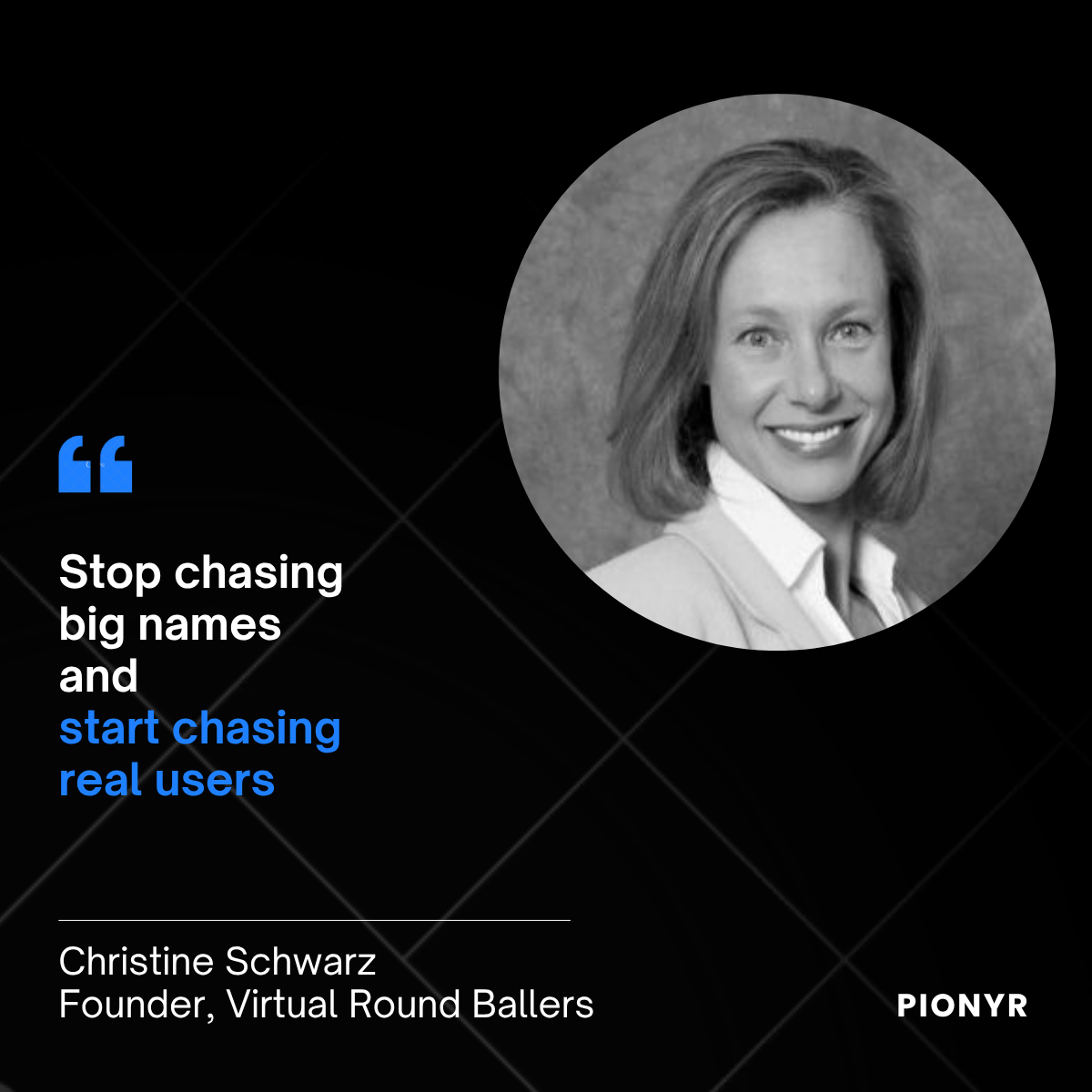
Christine Schwarz is the founder of Virtual Round Ballers (VRB), a movement-based VR sports platform making sports accessible to the fans who love the game but lack the skills, confidence, time or resources to play.
You're building VRB without VC backing in a space full of well-funded incumbents. What gap are you uniquely positioned to fill?
I know what it feels like to be left out of the game. As a first-generation American, I didn't pick up a ball until high school and then got cut from every team I tried out for. Sports eventually taught me "I can't" was never an option, and that lesson carried me through winning an ESPN Muscle Mania title, turning around a $20M company post-recession, and drafting legislation that became law.
VRB exists so the next generation of kids doesn't have to wait until adulthood to find that lesson.
You've landed meetings with Comcast, ESPN, and national basketball leagues with no PR firm or budget. How do you turn a cold connection into a real opportunity?
I'm fearless and targeted in my outreach. I research who would benefit most from VRB, tailor my pitch to fit them, and reach out directly by telling people what I'm building, what I need, or asking for a specific intro. I vet events the same way, focusing on VR, gaming, sports, and brand sponsorships. I'm also in every Chicago founder group, on Sports Business Journal zoom calls about basketball and women's sports, and subscribed to sports tech, basketball, and startup newsletters. Then I cold-message anyone I read about on LinkedIn. We cold-called NBA teams to test our MVP, and the Cleveland Cavaliers were the most receptive, winning us the G-League Partnership of the Year award.
Turning cold connections into real opportunities is really about matching the angle to the audience.
Gaming and immersive tech is crowded. What's your playbook for getting in front of the right people?
The right people for VRB are the players themselves and the partners who already have their attention and they're rarely where VR devs are fighting for visibility. That's my real edge: I don't come from gaming.
Most developers wait to be found on the app store. I treat VRB like a business with a marketing problem and find where our audience already is and meet them there.
You built your revenue model on sponsorships instead of VC. What made brands say yes?
We initially tried cold outreach to brands and agencies and it went nowhere. Through our relationship with the Cavs we connected to an agency that taught us how brands evaluate activations. From LinkedIn I found a consultant who analyzes and writes extensively about digital sports sponsorship campaigns and offers free 30-minute calls. I was able to validate my offering and pricing and he provided an intro and a roadmap for what brands need to see. While exhibiting at a conference, a small experiential agency approached me and now will be pitching together. My advice is to find the thought leaders who write about sponsorship in your industry and feed their content into AI to analyze and create your value proposition and test it with a connection in the space. Attend industry events where brands and sponsors are in attendance to make connections (IRL>online). Approach smaller agencies who are more open to innovation (you can find them on LinkedIn based on their posts) than the big ones, who tend to repackage what they already do. Pitch brands directly and partner with an agency for footprint and digital. Build a comprehensive plan because everyone's overworked, so do the thinking for them which they will appreciate.
And always begin with a small pilot to get you to a yes.
Building this without VC or a playbook, juggling product, sales, and partnerships, what's the one thing you wish someone had told you at the start?
I wish someone had told me to stop chasing big names and start chasing real users. In the beginning, I focused on pitching VCs and NBA players for investment, and chasing team partnerships which felt like milestones. But none of that gets a product into players' hands. What I should have done is run leaner and focus everything on a scrappy beta in the Quest app store with real playtesters.
That's where actual validation comes from: people you don't know choosing to play your game, returning to it, telling their friends about it.
Christine Schwarz is the founder of Virtual Round Ballers (VRB), a movement-based VR sports platform making sports accessible to the fans who love the game but lack the skills, confidence, time or resources to play. A first-generation American who didn't pick up a ball until high school, she was cut from every team she tried out for. That experience combined with her lifelong passion for fitness and the power of sports drives everything she builds today.
A strategic executive with a talent for building relationships across teams, partners, and policymakers, Christine has led cultural and operational turnarounds across SMBs and startups in finance, accounting, operations, and marketing with a deep focus on fitness and wellness throughout, from working for fitness equipment companies to serving as wellness chairperson for a K–8 public school district. Along the way, she won an ESPN Muscle Mania title, turned around a $20M company post-recession, launched a premium fitness brand into a luxury national chain, and drafted legislation that became law with bipartisan support.
Real founder playbooks, straight to your inbox.